
Measure. Improve. Dominate.
Overall Equipment Effectiveness (OEE)
Maximize manufacturing productivity with real-time insights into Availability, Performance, and Quality — the three pillars of world-class OEE.
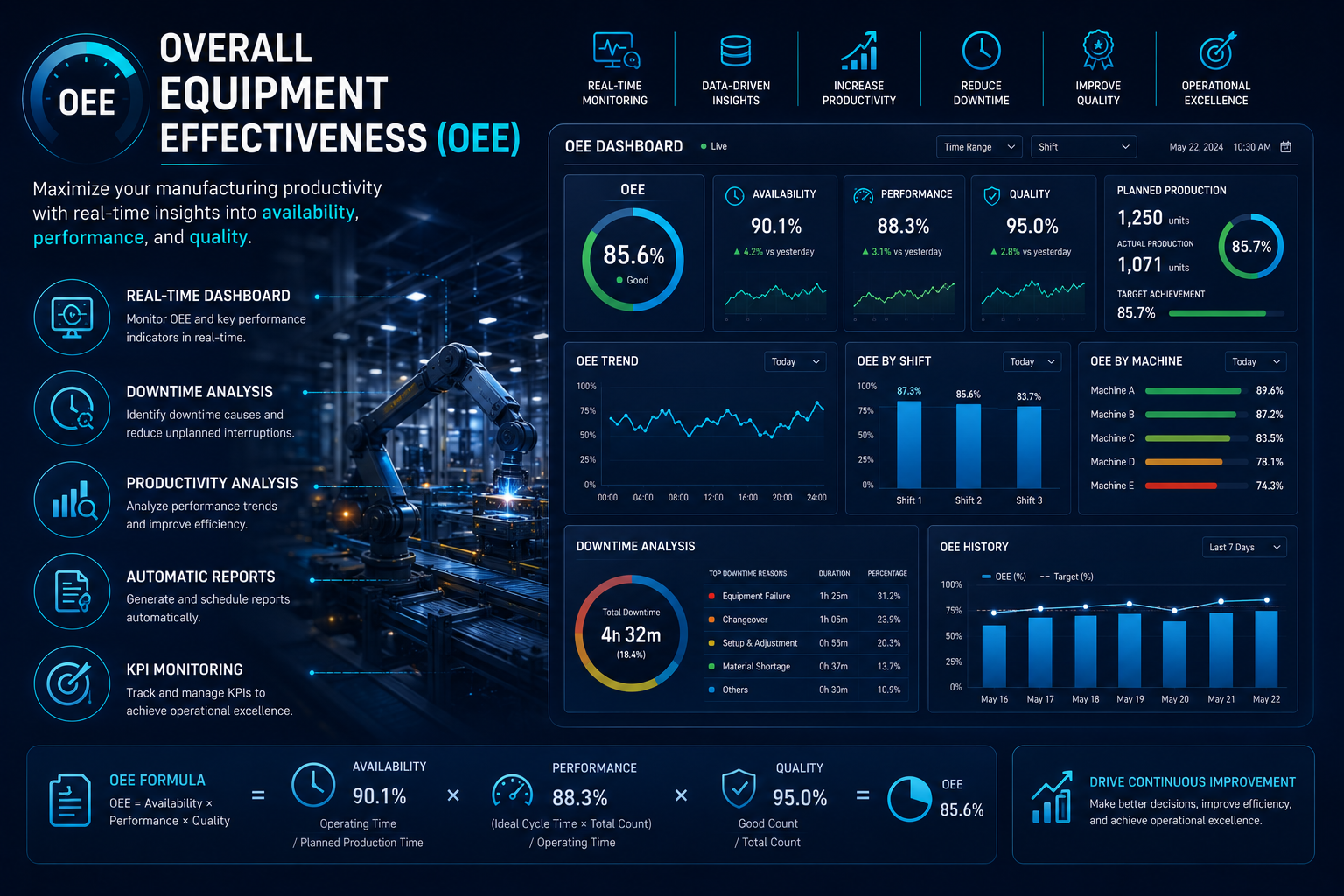
Overview
Overall Equipment Effectiveness (OEE) is a measurement method used to evaluate the effectiveness of machines and equipment in the production process. OEE helps companies identify production losses based on three key factors:
- Availability: Measures the actual machine operating time compared to the planned production time.
- Performance: Measures the actual operating speed of the machine compared to its ideal speed.
- Quality: Measures the number of good-quality products compared to the total products manufactured.
The basic OEE formula is:
OEE=Availability×Performance×Quality
Comparison: Systems With and Without OEE
| With an OEE System | Without an OEE System |
|---|---|
| Machine effectiveness can be measured objectively | Machine performance is difficult to measure accurately |
| Downtime can be monitored and analyzed | Causes of downtime are often not properly documented |
| Sources of production losses are easier to identify | Production issues may only be identified after causing significant impact |
| Decisions are based on accurate data | Decisions are often based on assumptions |
| Productivity and quality can be evaluated regularly | Production evaluations are less structured |
| Improvement programs are more focused and measurable | Improvements tend to be reactive |
Benefits of Using OEE
Implementing OEE provides several benefits, including:
- Improving machine effectiveness and productivity.
- Reducing downtime and unplanned equipment stoppages.
- Identifying the root causes of production losses.
- Improving production speed and process stability.
- Reducing defective products, rejects, and rework.
- Supporting data-driven decision-making.
- Helping prioritize machine maintenance and improvement activities.
- Encouraging continuous improvement.
With OEE, companies can monitor production performance more effectively, identify improvement opportunities, and optimize equipment utilization to increase productivity, quality, and operational efficiency.
Solutions
Choose a Solution
Need this solution?
Our engineering team is ready to design and implement a custom Overall Equipment Effectiveness (OEE) strategy for your facility.
Contact Our ExpertsIncrease OEE to 85%+
Cut Unplanned Downtime
Boost Throughput
Reduce Scrap & Rework
Technologies We Use
Key Features & Capabilities
Comprehensive capabilities designed to transform your operations from the ground up.

Real-Time OEE Dashboard
Live multi-level dashboards — from machine-level to plant-wide rollup — with color-coded OEE scores, trend charts, and shift comparisons. Accessible from any device including mobile and control room displays.
Automated Downtime Tracking
Automatic detection and categorization of machine stops — planned vs. unplanned, breakdown vs. changeover. Eliminates manual operator log books and delivers accurate downtime Pareto analysis in real-time.
Production & Shift Reporting
Automated shift, daily, weekly, and monthly reports emailed directly to management. Custom KPI templates for line leaders, shift supervisors, and production directors — each seeing the data most relevant to their role.
Downtime Root Cause Analysis
Drill-down from plant OEE to line to machine to specific fault code. Integrated cause-and-effect tagging lets operators capture the 'why' behind every stop, feeding a continuously improving failure database.
Quality & Scrap Tracking
Integration with weighing scales, vision systems, and manual reject counters to capture First Pass Yield in real-time. SPC control charts detect quality drift before specification limits are breached.

AI Performance Analytics
Machine learning models analyze historical OEE patterns to predict future performance drops, recommend optimal maintenance windows, and identify which machines will benefit most from improvement investment.
With Overall Equipment Effectiveness (OEE)
Measurable results that impact your bottom line.
Increase OEE to 85%+
World-class manufacturers target 85% OEE. Our customers average a 15-22 percentage point improvement within 12 months.
Cut Unplanned Downtime
Automated alerts and root cause tracking reduce mean time to repair (MTTR) and eliminate recurring failures.
Boost Throughput
Speed loss detection and targeted line balancing drive additional output from the same equipment and headcount.
Reduce Scrap & Rework
Real-time SPC and quality monitoring catch defects at the source before they propagate down the line.
Real-World Use Cases
Proven implementations across industries that deliver tangible results.
Cement Plant OEE Transformation
Deployed OEE monitoring across 12 production lines. Automated downtime logging replaced paper-based shift logs, surfacing that a single pneumatic valve was responsible for 18% of all unplanned stops. OEE improved from 62% to 84% within 6 months.
Automotive Parts Stamping
Real-time OEE dashboards on 24 stamping presses revealed chronic speed losses during afternoon shifts due to die temperature. Targeted cooling upgrades delivered a 9% throughput increase with zero capital on new equipment.
Food & Beverage Filling Lines
OEE integration with filling and capping machines reduced average changeover time by 35% through data-driven SMED analysis, adding the equivalent of one full production shift per week.
Ready to Transform Your Operations?
Let's discuss how our overall equipment effectiveness (oee) solution can help your business achieve measurable improvements.